Coffee Fines: What They Are and How They Affect Brewing
When coffee beans are ground, they produce particles of many different sizes. Some are relatively large, while others are small enough to look almost like powder.
These tiny particles are known as coffee fines.
Although fines make up only part of the ground coffee, they can have a noticeable effect on extraction, brewing time, mouthfeel, and water flow. They can also interact closely with the coffee filter paper, affecting filtration speed and cup clarity.
So, what exactly are coffee fines, and why do they matter?
What Are Coffee Fines?
Coffee fines are the smallest particles produced during the grinding process.
Coffee beans do not break into particles of one uniform size. Their internal structure varies, so grinding naturally creates a range of particle sizes. Even a well-designed grinder will produce some fines.
The important point is that fines are not necessarily a defect.
Because they are extremely small, fines have a relatively large surface area compared with larger coffee particles. This allows water to interact with them quickly during brewing.
As a result, coffee fines can have a much stronger influence on extraction than their quantity alone might suggest.
How Do Coffee Fines Affect Coffee Extraction?
Particle size has a direct relationship with extraction.
Smaller coffee particles expose more surface area to water, while the distance for water to penetrate the particle is also shorter. This allows soluble coffee compounds to dissolve more quickly.
This is why fines can contribute significantly to extraction during brewing.
A moderate amount of fines can help develop flavor and contribute to a fuller cup. However, because they extract quickly, excessive fines can also increase the risk of over-extraction.
When too many highly extractable particles are present, the brew may develop unwanted bitterness, astringency, or a dry sensation.
In other words, the goal is not simply to maximize extraction.
Balanced extraction is what matters.
How Do Coffee Fines Affect Mouthfeel?
Coffee fines can also influence the texture of brewed coffee.
Some very small particles may remain suspended in the beverage, together with coffee oils and other compounds. This can contribute to a heavier and fuller mouthfeel.
This is one reason different filtration methods can produce noticeably different cups, even when the same coffee and brewing recipe are used.
A small amount of fine material may add body and texture.
However, excessive particles can create a dusty, gritty, or rough sensation. For brewers looking for a cleaner cup, controlling the amount of fine material that reaches the final beverage becomes especially important.
Coffee Fines and Water Flow
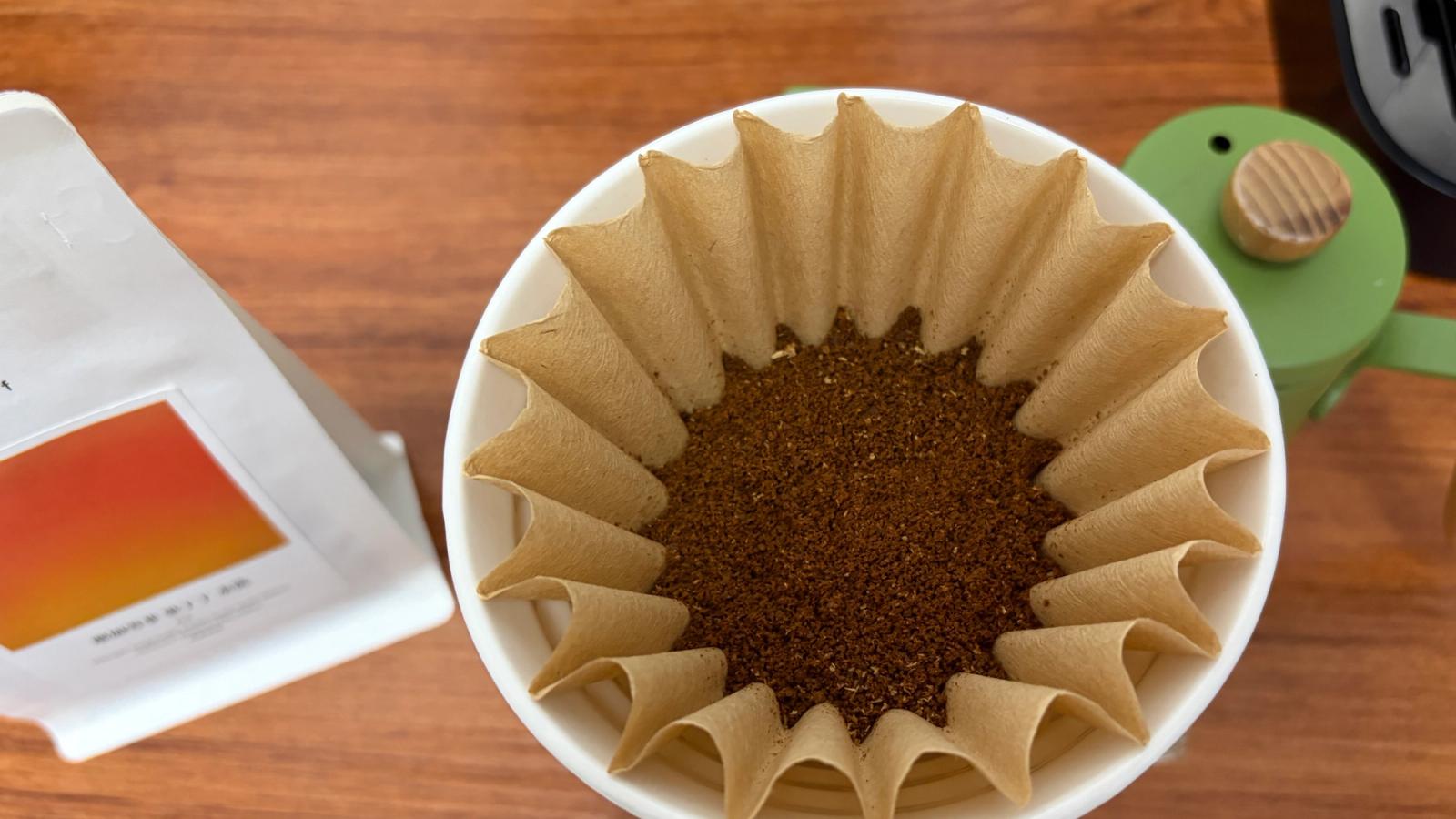
Coffee brewing takes place inside a porous coffee bed.
The spaces between coffee particles allow water to move through the bed. Since the particles are not all the same size, these spaces are also not uniform.
Coffee fines can move into the gaps between larger particles and increase resistance to water flow.
In the right amount, this can slow the flow and increase contact time between water and coffee.
But when fines accumulate excessively, they may create areas with much higher resistance. This can make the water search for easier pathways through the coffee bed.
The result can be uneven water distribution, commonly known as channeling.
What Is Channeling in Coffee Brewing?
Channeling occurs when water flows preferentially through certain parts of the coffee bed instead of passing through it more evenly.
This creates an uneven extraction pattern.
Some areas may receive too much water and become over-extracted, while other areas receive too little and remain under-extracted.
The final cup may therefore show a combination of unpleasant characteristics, such as excessive sourness, bitterness, or astringency.
Coffee fines can contribute to this problem when they migrate through the coffee bed and accumulate in areas where water needs to pass.
This makes the behavior of fines an important consideration when trying to achieve a stable and repeatable brewing process.
How Do Coffee Fines Affect Coffee Filter Paper?
Coffee filter paper does more than separate coffee grounds from the final beverage.
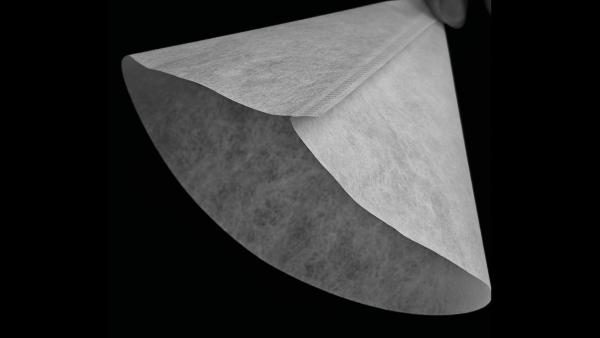
During brewing, water passes through a network of cellulose fibers while coffee particles are retained by the filter structure.
Because fines are very small, they can move with the water toward the filter and become trapped within or on the surface of the paper.
As fines accumulate, they can increase resistance to water flow.
This may lead to:
- Slower filtration
- Longer brewing time
- Increased contact between water and coffee
- Higher extraction
- Changes in cup clarity and mouthfeel
The actual effect depends on several factors, including the coffee particle distribution, filter structure, paper permeability, brewing method, and pouring technique.
This is why coffee filter paper cannot be evaluated simply by asking whether it "filters well."
The more useful question is:
Does the filter provide the right balance between flow, particle retention, and cup clarity for the intended brewing method?
Why Does Coffee Filter Paper Sometimes Clog?
Filter clogging is often related to the interaction between fine particles and the filter structure.
As brewing progresses, fines can migrate toward the paper and accumulate on its surface or within its fiber network. This can gradually reduce the rate at which water passes through the filter.
The result is a brew that takes longer than expected.
This is particularly noticeable when a coffee produces a relatively high amount of fines or when the filter has a structure that retains a large amount of fine material.
For filter paper manufacturers and coffee brands, this makes flow rate and particle retention important characteristics to consider during product development.
Why Can Different Coffees Produce Different Brew Times?
Even when the same brewing recipe is used, different coffees can behave differently.
The grinder, roast level, bean structure, grind setting, particle distribution, and brewing technique can all influence the amount and movement of fines.
The filter is another important variable.
Different filter papers can have different fiber structures, thicknesses, permeability, and particle-retention characteristics. These differences can change how quickly water moves through the coffee bed and the filter.
This is why a filter that performs well with one coffee may produce a different brewing time with another.
For commercial coffee brands, finding a suitable filter often means considering the entire brewing system rather than looking at the filter paper in isolation.
How Can Coffee Fines Be Better Controlled?
There is no need to eliminate every fine particle.
Instead, the goal is to create a more predictable relationship between the coffee particles, water, and filter.
Several factors can help:
Grinder performance: Different grinders produce different particle distributions, even at similar grind settings.
Grind size: Changing the grind setting changes the overall particle distribution and can influence the amount of fines.
Brewing technique: Pouring speed, agitation, and water distribution can affect how fines move through the coffee bed.
Filter paper: The paper's fiber structure, permeability, strength, and particle-retention characteristics can all influence filtration performance.
Together, these factors determine how water moves through the brewing system.
Choosing the Right Coffee Filter Paper
For coffee brands, roasters, and filter manufacturers, filter paper is an important part of the brewing experience.
A suitable coffee filter needs to provide more than basic filtration. It should offer a practical balance between:
- Stable flow rate
- Particle retention
- Filtration efficiency
- Cup clarity
- Mechanical strength
- Consistent performance
Different brewing formats may also require different filter characteristics.
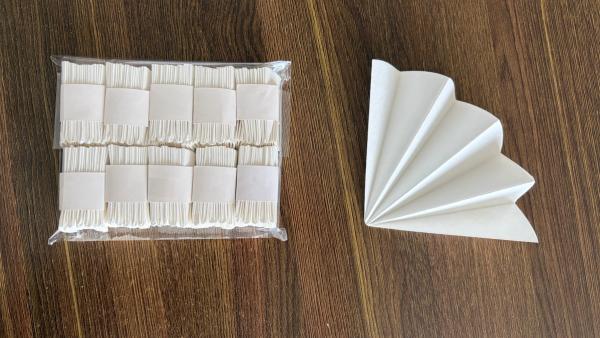
Conical filters, basket filters, wave-style filters, and other coffee filtration formats can have different requirements for paper structure and flow behavior.
That is why coffee filter paper development is not simply about making the pores smaller or larger.
It is about finding the right combination of fiber structure, permeability, strength, and filtration performance for the application.
Final Thoughts
Coffee fines are tiny, but their influence on brewing is significant.
They can increase extraction, contribute to body, slow water flow, affect brew time, and interact directly with coffee filter paper.
The key is not to treat fines as simply "good" or "bad."
Instead, it is better to understand how they behave as part of the complete brewing system.
Coffee beans, grinder, water, brewing technique, and filter paper all work together.
When these factors are properly balanced, it becomes easier to achieve a cleaner, more consistent, and repeatable cup.
At Usesoon, we develop coffee filter paper for different brewing applications, with a focus on filtration performance, flow characteristics, particle retention, and consistent quality.
Because in coffee filtration, even the smallest particles can make a big difference.